
Mice in your student room in Groningen
Droppings in the kitchen cupboard, or scratching behind the wall at night? You are not the only one. Mice are common in student housing in Groningen, especially from September onwards. They can also pass on disease, so it is worth acting quickly, and you can book us directly without waiting for your landlord.
Mice in student housing: what to do first
Most student houses in Groningen are old, close to water and full of food. That is everything a mouse needs. One mouse in the kitchen usually means a nest somewhere in the wall, under the floor or behind the kitchen units. Mice breed quickly, so waiting a few weeks makes the problem harder to solve, not easier.
Mouse or rat? Check the droppings first
Mouse droppings are the size of a grain of rice, three to six millimetres. If they are around two centimetres and thicker, you are dealing with rats, and that is a more urgent problem. In that case read rats in your student house in Groningen instead.
How do you know it is mice?
You will rarely see the mice themselves. You will see their traces:
- Droppings the size of a grain of rice, three to six millimetres, usually in cupboards and drawers
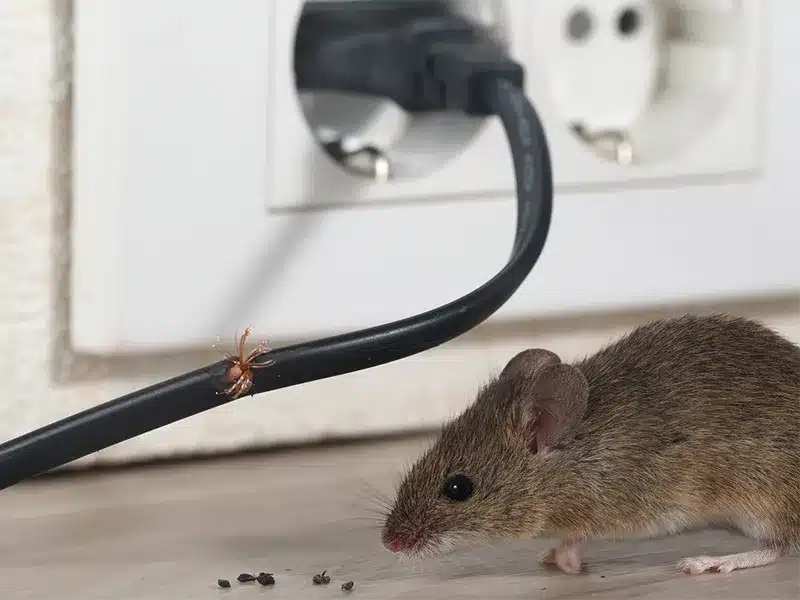
- Gnaw marks on food packaging, bread, and sometimes on cables
- Nesting material: shredded paper, insulation or fabric, often behind the fridge or under the sink
- A sharp, ammonia-like smell in a cupboard or corner
- Scratching at dusk and at night, in the wall, behind the skirting board or above the ceiling
Mice can make you ill, and that is why speed matters
A mouse in the kitchen is not just annoying. Mice run through drains, bin areas and crawl spaces and then walk over your worktop, your plates and your food. They leave droppings and urine wherever they go and they cannot hold it in, so a cupboard they visit is contaminated within days.
Through that contamination mice can pass on salmonella and other food-poisoning bacteria, and they are carriers of leptospirosis and hantavirus as well. Dried droppings and mouse hair are a common trigger for asthma and allergic reactions, which you notice most in a small room. And because mice gnaw on cables, they are a fire risk in an old student house.
This is not a reason to panic, but it is a reason not to leave it for a few weeks. Throw away food that has been in a cupboard with droppings, clean the cupboard, and get the problem dealt with. Call 06-22528717 or send us a message and we will tell you what you are dealing with.
Who pays? You do not have to wait for your landlord
You can arrange this with us directly. You call or email, we come out, and you get an invoice in your own name. You then send that invoice to your landlord and ask them to reimburse it. You do not need their permission, and you do not have to wait for them to organise anything.
In the Netherlands vermin in a rented home is normally a defect the landlord has to put right, unless the tenant caused it, so the cost usually ends up with them anyway. We set all of it out, including an email you can copy, on who pays for pest control in student housing in Groningen.
What you can do today
While you wait, you can make your room much less attractive. Keep all food in sealed containers or in the fridge, including pasta, rice, cereal and pet food. Take the bin out every day. Clean up crumbs behind the toaster and under the kitchen units. Do not leave dirty dishes overnight in a shared kitchen.
Please do not buy poison from a supermarket or hardware shop. A poisoned mouse often dies inside a wall or under the floor, and then you have a smell you cannot reach for weeks. It also puts other animals at risk.
What we do when we come out
We find the nest and the routes the mice use, place bait boxes and traps where they actually run, and then close the openings they come in through. A mouse gets through a gap of about six millimetres, so a gap under a door, a pipe duct or a vent without mesh is enough. Closing those is the part that makes the difference; everything else is temporary.
We work throughout the city of Groningen and the surrounding area. If you would rather we spoke to your landlord ourselves we can do that, but you do not have to wait for it.
Housemates, and the rest of the building
Mice do not stop at your door. If you share a kitchen or a hallway the nest is often not in your room at all, so in a house with several rooms we usually treat the whole building rather than one room. It works better and it is cheaper per room.
You can book that together with your housemates. One invoice for the house is also easier to put in front of a landlord than five separate ones.
Are you a landlord or property manager yourself? Then have a look at our Dutch page about ongediertebestrijding voor verhuurders en studentenhuizen.
Also in Dutch
Prefer to read this in Dutch, or want to send the page to your landlord? Our Dutch page on muizenbestrijding in Groningen covers the same subject.
FAQ
Frequently asked questions
The questions students in Groningen ask us most often.
How do I know I have mice and not rats?
Mouse droppings are the size of a grain of rice, three to six millimetres. Rat droppings are around two centimetres. Mice are also much lighter on their feet: with rats you hear real gnawing and thumping, with mice a fine scratching or rustling.
Can mice make you ill?
They can. Mice contaminate food and surfaces with droppings and urine, and can pass on salmonella and other food-poisoning bacteria, as well as leptospirosis and hantavirus. Dried droppings and hair also trigger asthma and allergic reactions. That is the main reason not to leave it: the longer they are there, the more contamination there is.
Who pays: me or my landlord?
You can book us directly and you get an invoice in your own name. Vermin in a rented home is normally a defect your landlord has to put right, so in most cases you can send that invoice on and ask to be reimbursed. We explain it step by step, with an email you can copy, on our page about who pays for pest control in student housing in Groningen.
Can you come if I am not the owner of the house?
Yes. You rent the room, so you can have it treated. We do not need your landlord’s permission or a reference number from a housing provider. You get the invoice from us and you settle it with your landlord afterwards.
How long does it take to get rid of mice?
For a normal student house, usually one to three weeks. We come back to check the bait boxes and to make sure nothing new appears. Closing the openings is what makes it permanent.
Is the treatment safe with housemates and pets around?
Yes. We use closed bait boxes that cannot be opened by hand, and we place them where people do not walk. We always tell you where they are.
Can I just buy poison at the supermarket?
We would advise against it. A poisoned mouse usually dies inside a wall or under the floor, and the smell can last for weeks in a place you cannot reach. It is also a risk for other animals.
Do you speak English?
Yes. You can call, email or send a message in English and we will answer in English.
Do you have a question about mice in your room?
Just ask
We are happy to help and we are reachable almost any time. We reply quickly to messages sent through this form.